A recent discussion came up on a mailing list I’m on related to building Software Defined Radios. Someone was asking about buying a cheap frequency counter just after getting into building things operating in the RF range. After spending a while writing a reply, I thought I would replicate it here for posterity sake. The basic question was ‘How much frequency counter do I need?’
The reply:
There are a ton of frequency counters available out there, I see some folks have already replied offering you a working cheap Chinese unit. My $0.02:
Once you get dragged into this hobby, you will need at least one frequency counter. There are a number of parameters that will help determine which one gets used for which job. They would be:
Range: Every counter has an upper limit, but keep in mind many also have lower limits. If you need to measure things below 10mhz, for example a microwave frequency counter just won’t help you out, nor will many cheap counters measure with any precision below 1Mhz. Conversely, if you plan to do much work above vhf, you’ll need a counter good to whatever your target is. And if you need to measure things dow at the 10hz or lower level with any accuracy or precision, you might want to look at other counters.
Accuracy: Just how accurate do you need your measurements? Every counter has a timebase as a reference. Some are better than others. A cheap counter will use a computer oscillator module that’s accurate to +/-100ppm. A Good counter will have an adjustable time base that has been calibrated to +/-1ppm from something traceable to NIST. A Very Good counter will have a temperature compensated double oven oscillator (OXCO) calibrated to within +/-.1ppm or better. A time-nuts suitable counter, aka Crazy Good, will be slaved to an oxco that is disciplined to GPS and be accurate to 1×10-12. After that you get into things slaved to cesium beam clocks or masers or the like and are far beyond any salvation. Many counters that fall into the ‘Good’ or better categories will have inputs and/or outputs for their time bases that will let you slave several together to a single time base, making them at least relatively correct to each other. As well as letting you slave a Good frequency generator to the same time base.
Precision: Just how many digits do you need? The more you need, the more you’ll spend. A cheap 2Ghz counter might be good down to a hz for under $50US. How accurate it is is a different question. An HP 5370 (which is far more than a simple frequency counter) is good to 4 decimal places at 10Mhz. And pretty accurate. And several hundred $US, if you find a bargain.
Input sensitivity: What is the strength of the signal you are trying to count? TTL? RF from an antenna? RF from a power amp? What impedance? Most Good counters have selectable input attenuation, but you’re still not going to be feeding a power amp into one.
Expected lifetime: Just how long do you want this thing to last? Cheap counter will last a few years. Brand new Agilent counter will outlive you. 25 year old HP/Agilent counter will probably last the rest of your hobby career.
Features: What are the things you want a counter to do besides frequency? Period? A to B time interval? A events during B? Adjustable gate? Sample size? Built in DVM? Built _into_ a DVM?
Cost: Related to all the above.
Additionally, you can often find a frequency generator with a counter input. The HP 8640b comes to mind. Good to 512Mhz (1024mhz with the doubler) and has a built in counter that you can use to count the output or to count from an external source. But not a great deal of precision. 6 digits iirc.
I’ll add that a freq counter was the first piece of ‘digital’ test equipment I bought, even before a DVM. That unit is still on my test equipment shelf but has been joined by at least 6 others covering different ranges, accuracies, form factors, and degrees of precision. 8 if you count counters built into frequency generators. 🙂
Similar arguments can be had about other instruments including DVMs, scopes, spectrum analyzers, etc, etc, etc.
More than you really wanted to think about I’m sure.
Current counter inventory:
HP 5370 Time Interval Counter.
HP 5328B w VE2ZAZ prescaler. W options 010, 011, 031. 0-13Ghz
Tektronix DC5010 with DP501 prescaler. OXCO option. 0-1.3Ghz.
Tektronix DC510 with DP501 prescaler. OXCO option. 0-1.3Ghz.
Tektronix DC505 plug in for 500/5000 series mainframes. 0-225Mhz
Tektronix 7D15 225Mhz counter plug in for 7000 series scopes (Now at W2SZ)
Ramsey DC501 0-1.3Ghz (No longer in service)
Solar 0-1Ghz inline RF counter.
Counters inherent in HP 8640B, DSA-602, Tek 1240 and DMM.
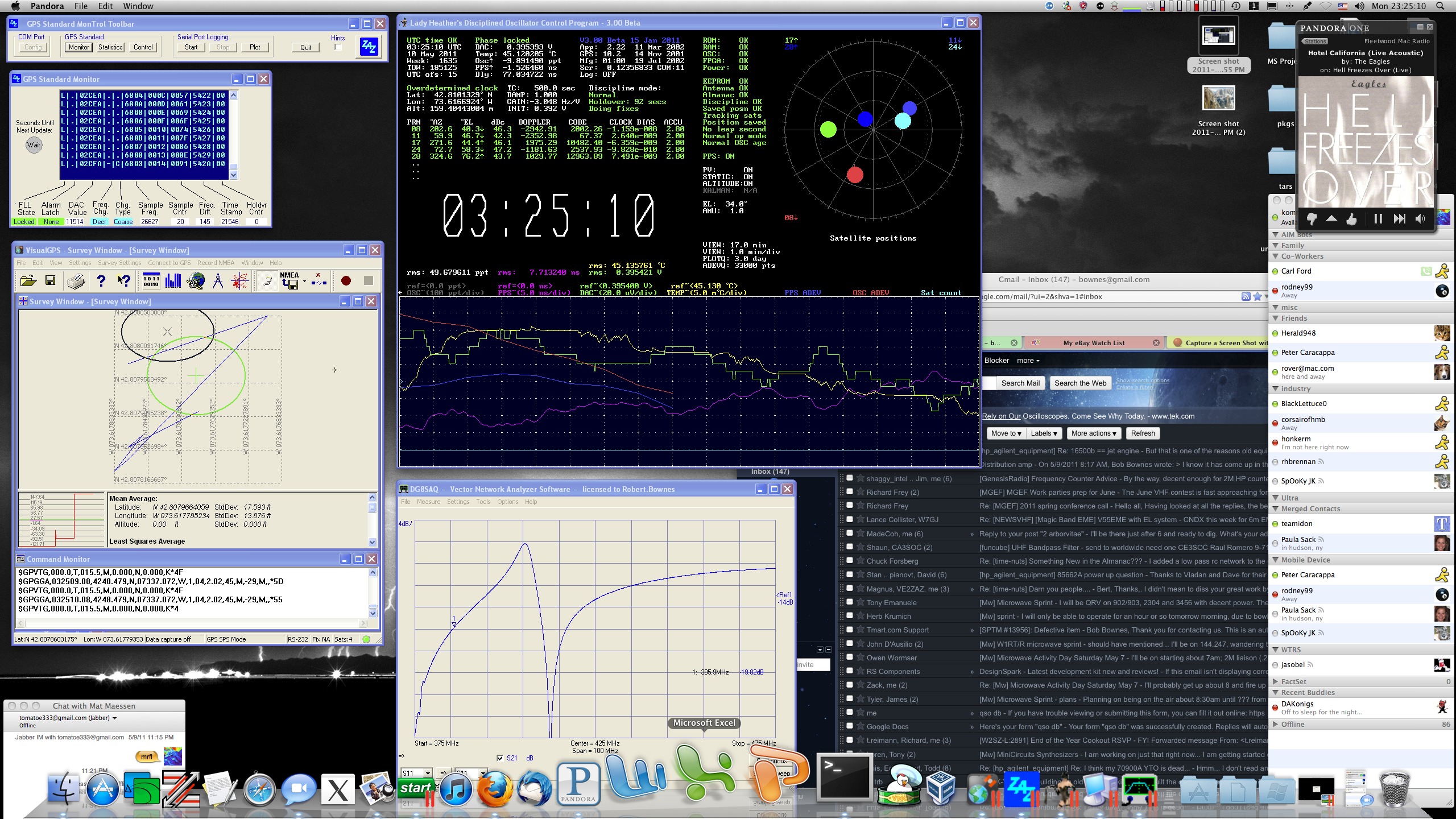
The HP 5370B, 5328B, 70820A and Tek DC5010 are slaved from a Thunderbolt 10Mhz GPSDO frequency standard, as are the HP 70340A, 8657A, 3325A and 83711A frequency generators.
All this lead to checking my two 10Mhz GPSDO’s against each other only to find an indicated frequency difference of 1bout 1.5Hz! Without a third, it’s hard to even vote on which one is correct. The problem looks to be the GPS unit in the VE2ZAZ GPSDO. More detail to follow.
3/1/2012: I have added a rubidium standard to the collection recently. Using that, it appears that the problem with the VE2ZAZ GPSDO is the OXCO is ill. I’ve not dug into it yet, but I suspect the heater is either non functional or otherwise not right since it is very temperature sensitive.
6/3/2016: Added a pair of HP 70000 Modular Measurement Systems in the last few years. With the inclusion of a 70820 Microwave Transition Analyzer or any of the spectrum analyzer modules and slaved to a GPSDO, this unit is a Very Good counter.
Even worse, the collection has expanded to include an HP 5061A Cesium Beam Standard, AKA an atomic clock.