02.11
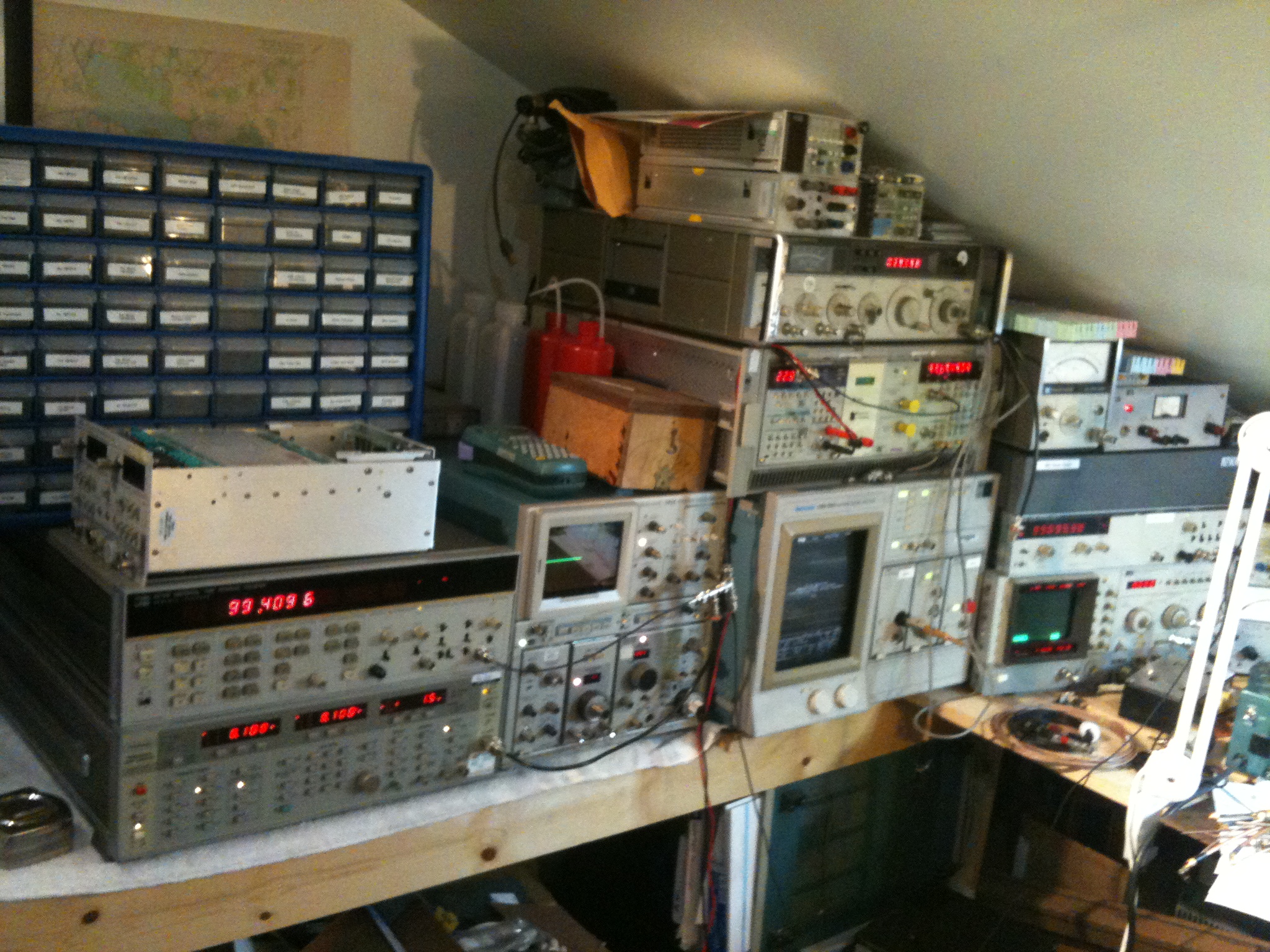
Someone asked me the other day what tools and test equipment they should buy if they were just getting into electronics. After getting past the simple, obvious things like screwdrivers, a breadboard, and a soldering iron, the discussion ended up focusing on test equipment. I came up with the following list of things to get, more or less in this order:
Digital Volt/Ohm Meter (DVM) – A simple DVM can be had from Harbor Freight for less than $10US. Be prepared to toss it in a few years, but for $10, how far wrong can you go? Don’t get sucked in by alot of crazy features that you will never use (like an RS-232 interface). A more advance, rugged, accurate, decent meter can be had on eBay for $30-$50.Look for a Fluke, B&K, or some other name you recognize.
Logic Probe – If you are working solely with digital electronics, this tool, which can tell you the logic status of a single line, is invaluable. It looks like a pen and has two or three LEDs to tell you the state of the line you touch the probe to. You can make your own digital version with a 74ls04 and an LED, but the commercial versions are more sensitive and don’t drag down the output of your circuit. Great bang for the buck at $5-$20, either assembled or as a kit.
Function (frequency) Generator / Counter – If you are testing circuits, it is often handy to have a signal source about. A simple digital oscillator is easily built from a 7400, a resistor, and a cap, but having something that you can change the shape of the signal (sine, square wave, triangle, sawtooth) as well as the frequency, maybe the duty cycle, amplitude, and even the offset, can turn out to be useful. Build your first one from a 74LS00, a cap and a trimpot. After that, look for a 0-2Mhz variant. Often you can find these with integral frequency counters so you know the frequency of the signal. Even better, often they will also take an external signal and allow you to route that to the counter, giving you two instruments for the price of one. $50-$100 on ebay.
Oscilliscope – Possibly the most important piece of gear you will purchase. Allowing you to look at the shape, levels, and frequency of signals, analog or digital. O’scopes come in a dizzying array of types, analog, digital, high bandwidth, storage, PC driven. Start simple. All you want to do is visualize the signals you are looking at. For simple digital electronics, a 5mhz single or dual trace scope will be all you need. Once you branch off into high speed digital or RF electronics, you’ll need more features and can start looking at a pricier scope. Due to fragility and shipping costs, the best place to find these is local used electronics stores, electronic flea markets, or hamfests. Expect to pay $50-$200 depending on age, condition, or features.
Once you have those basic tools, everything else is pretty much an enhancement or a refinement of one of the above. Better counters for the frequency ranges you work in, analyzers to look at signal quality or frequency, function generators with more features, such as sweep generators, and the like get really handy. As do more DVM’s (you need to measure more than one thing at a time sometimes), multiple output power supplies, and the inevitable plethora of specialty tools.
The tools I followed up an o’scope with are:
Logic Analyzer – Very handy for tracking the state of 8-256 data lines, a logic analyzer is essentially N logic probes ganged together. The simplest version is a buffer followed by an LED and resistor to show you the state of a few lines of logic. However, for a very reasonable price (Under $50 + shipping) on ebay, you can get a logic analyzer such as the Tektronix 1240/1240. Shop carefully however. Make sure it has channel cards and probes. You’re better off with fewer channels and probes than you are with many channels and no probes.
For RF work, the following have proven really handy:
RF Power Meters – The Right Tool(TM) for measuring the output of that transmitter or amplifier you’ve built. RF power meters come in ranges, based on the frequency of the signal you want to measure. HF power meters are usually simple and cheap, while those used for microwave are equally simple, but often not cheap. Microwave range meters such as the HP 432A and 435A are great for a few milliwatts of microwave and are decently cheap ($10-$20US), but they require sensors (also called sensor heads) that can cost anywhere from $50 to $200 each. Try to find one with sensors already. HF/VHF/UHF meters are much easier to find and rarely require heads. If you can live with 10% resolution, expect to pay $50 for a decent SWR/power meter. However, if you want to really get the Right Tool(TM), you are going to be buying a Bird Model 43 Throughline Wattmeter. Good from a few milliwatts to over 50KW and frequencies from about 100Kz to over 2Ghz, the Bird is the tool. As with the HPs, the meter is the cheap part. Bird meters use interchangeable elements (also known as ‘slugs‘) to set the wattage and frequency range of the meter. Expect to pay up to $200 for the meter and maybe one slug, then $30-$150 per slug on eBay. The slugs you want are always the expensive ones.
Spectrum analyzer – Often mistaken as an oscilliscope due to the similar appearance, the Spectrum Analyzer displays a signal not in the time domain, as an oscilliscope does, but in the frequency domain. A trace on the specan shows you what frequencies are contained in that signal you are generating. Of what use is that? It allows you to make sure you are transmitting what and where you though and within the bandwidth you are trying to hit. A spectrum analyzer is also handy for tuning filters to pass or notch out a particular frequency.
RF Network Analyzer – Available in two types, scalar and vector, the RF network analyzer sweeps through a frequency band and shows you the response of a device under test (usually a filter or antenna) in either just the amplitude (scalar) or amplitude and phase (vector). The perfect tool for tuning antennas and filters from a few hundred khz to tens of ghz. Build one yourself for a few hundred $ or pick up a used one from a few hundred $ to several thousand.
Lastly, and only if you are something of a nut, you might want:
GPS Disciplined Oscillator – Using the GPS satellite network to provide a very accurate time reference, a (typically) 10Mhz oven controlled oscillator is controlled to produce a very accurate 10mhz signal used as a reference by all your other instruments, function generators, counters, spectrum analyzer, and even oscilloscopes. How accurate? Depending on your ability to keep temperature swings to a minimum and the power supply from introducing phase noise, you can get down to 1×10-12 pretty easily and 1×10-13 with some work. You can drive the NTP clock on your computer network with it too if you so desire. Who wouldn’t want a stratum 1 clock at home?